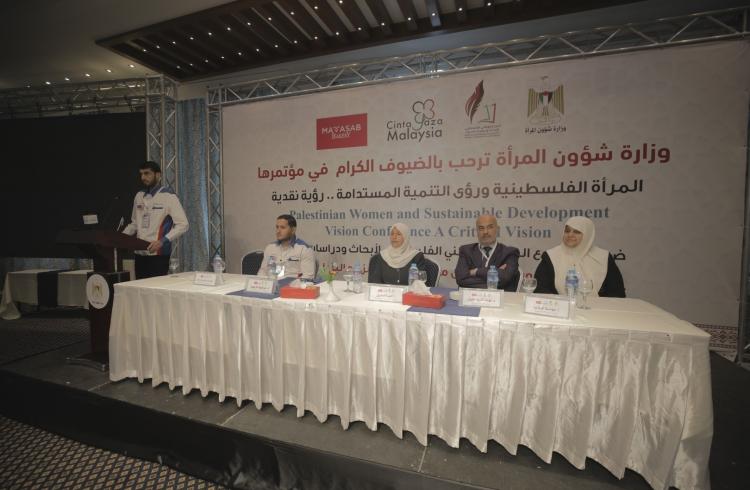
Speakers at the Conference on "Palestinian Women and Visions of Sustainable Development: a critical vision" emphasized the competence of Palestinian women and their ability to challenge, manage economic projects, and contribute to development if the means are available to them to do so; the first of which is to end the occupation that obstructs development in Palestine in general.
Several papers concluded that there are female models who have achieved success despite all the obstacles and lack of capabilities. They have the will to challenge and a real desire to build, preserve the family and children, and empower them despite the siege and the crippling conditions of the occupation.
This came in a conference held by the Ministry of Women’s Affairs within the activities of the Palestinian National Center for Women’s Research and Studies funded by the Cinta Gaza Malaysia, in Gaza City on June 21, 2022, with the participation of several researchers in various disciplines related to women’s issues, where 14 female researchers and 6 male researchers contributed in preparing 16 research papers.
The participants also emphasized that the concepts launched by the United Nations about sustainable development and its projects that it managed inside Palestine directly or through partner institutions have ended in great failure. Nearly $35 billion has been spent, unemployment has increased, consumption has doubled, and settlement has been strengthened in the occupied West Bank. Standards did not fit with the first and foremost factor, as the fact is that the occupation still exists in Palestine and directly prevents development.
At the beginning of the conference, the Undersecretary of the Ministry of Women’s Affairs, Mrs. Amira Haroun, welcomed the attendees and participants; the owners of papers and committees working on the success of the conference and its management and thanked the beloved staff of Cinta Gaza Malaysia for the support they provide to Palestinian women, which stems out from their full belief in their rights and support for their causes in Palestine.
She also stressed the importance of the conference and its theme, saying, "This moment of high-level participation does not stop at being a participant in a conference, but extends to the fact that it redefines collective awareness and understanding of global trends that affect the issue and Palestinian women."
Director of PALM Strategic Initiatives Center, Dr. Ibrahim Al-Zaeem, after welcoming the attendees, expressed his pride in the Islamic law, which shows us everything necessary for our lives in the verses of the Noble Qur’an, and emphasized the content of the papers and their waiting to be translated and published for the benefit of the people in Palestine and Malaysia. He said, "We always say we are with this issue until the establishment of the state and then its construction."
The conference included three sessions. The first session was about Palestinian women and development in the context of national liberation movements. Moreover, the second was about women’s participation in economic and development work, and the third was about the role of Palestinian women in pioneering work and promoting development visions.
Several researchers from universities and local institutions from inside the Gaza Strip participated in the conference with several papers within the previous axes. In addition, Dr. Camelia Helmy, head of the International Islamic Committee for Women and Children from outside the sector, spoke in her speech about the criticism of the concepts of sustainable development that the United Nations wants for our people, especially those that contradict our Islamic and national values and concepts, which have proven with experience as well as their opposition to real development and its foundations, especially in our Arab countries and in Palestine Until now.
The conference came out with several recommendations. The most important of which is urging the need for government attention and coordination with women’s institutions in setting real economic and development plans in line with local reality, real needs and actual projects that women can undertake, especially after women have proven their competence in several projects and successes they have achieved on the ground. Despite all the difficulties.
The conference also recommended the need to pay attention to local development that enhances steadfastness and popular confrontation with the occupier, as it was before the Oslo Agreement. It directed the development and linked it to the existence of the occupation, which affected the Palestinian economy and established dependence on the occupation, and removed the character of steadfastness and confrontation from the Palestinian economy than it was before.
The participants called for the promotion of the nature of development training provided to women entrepreneurs, the diversification of the programs offered to them in proportion to their abilities, and the development of training in micro projects in society, especially with the ability of women to carry out multiple and different projects. Also, they called for the significance of the government's support for these projects by reducing taxes and facilitating the legal procedures for licensing projects for women, as these difficulties are considered among the most important factors in the failure of projects and the abandonment of women.


