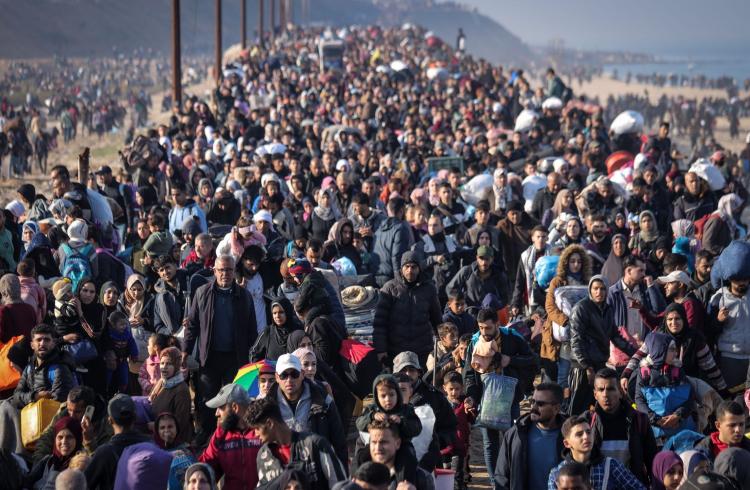
At the outset of the genocidal war on Gaza, and in an attempt to capitalize on the events of October 7, the Israeli occupation government set a plan to forcibly displace the majority of Gaza Strip residents. However, the plan failed due to the steadfastness of nearly 400,000 Palestinians who remained in the northern part of the Strip.
Despite this failure, the displacement plan remains in effect, with Prime Minister Benjamin Netanyahu and his partners insisting on pushing it forward. One of the most recent attempts was the occupation government’s approval, months ago, to open the Rafah Crossing in one direction only—allowing departures from Gaza while preventing return.
Following U.S. pressure to move toward the second phase of the ceasefire, and Egypt’s insistence on opening the crossing in both directions, Netanyahu agreed to reopen it under strict conditions, subjecting returnees to heavy security screening through a military checkpoint or inspection point located hundreds of meters away from the Rafah Crossing.
In the coming phase, the Israeli government is expected to adopt several strategies to implement what it refers to as “voluntary migration,” most notably:
1. Facilitating departures through Rafah and Kerem Shalom crossings under humanitarian pretexts—such as medical cases, students, and coordination permits—while severely restricting the return of residents through Rafah.
2. Delaying reconstruction efforts to create an unliveable and repellent environment, including the promotion of projects such as the so-called “Green City” east of Rafah, aimed at prolonging the reconstruction process.
3. Maintaining various forms of blockade to sustain pressure on Gaza and reinforce the conditions of forced displacement.
The Israeli government justifies these policies by citing resistance weapons and tunnels, the potential re-empowerment of Hamas, and the claim that what remains of Gaza is still under Hamas’ direct or indirect control—even in the event of a “Peace Council” or a U.S.-backed technocratic government.
Compounding the situation is Netanyahu’s vested interest in perpetuating a state of war—whether in Gaza or elsewhere in the region—for pressing domestic political reasons, particularly given the overlapping political timelines of both Netanyahu and Donald Trump remaining in power.
This reality necessitates heightened caution on the part of the resistance in Gaza, especially amid the complexity of the political landscape, the absence of effective pressure mechanisms, and the evident weakness of the Arab and Islamic response. It also underscores the importance of dismantling all pretexts and justifications that enable the continuation of pressure and collective punishment against Gaza.
The Forced Displacement Plan Is Still in Place
Jan 18, 2026 05:51 pm